Blog Feed

Richard Joweni, Ketua Dewan Militer TPN/PB Meninggal Dunia

Jayapura, Jubi – Brigadir Jenderal Richard Uria Joweni, Ketua WPNCL dan Ketua Dewan Militer Tentara Pembebasan Nasional Papua Barat (TPN/PB) tutup usia pada tanggal 16 Oktober 2015, pukul 23.00 di Port Numbay, Papua Barat.

Almarhum menderita komplikasi saluran pencernaan, dan telah menjalani perawatan intensif selama satu tahun terakhir. Selama 73 tahun hidupnya, almarhum telah mengabdikan diri demi memperjuangkan pembebasan negeri dan bangsa Papua Barat.

Selama masa hidupnya, almarhum memimpin TPN/PB setelah pernah ditunjuk oleh Seth J. Rumkorem sebagai menteri penerangan dalam kabinet revolusi Papua Barat yang dibentuk Rumkorem. Pada 1 Juli 1982 Richard Joweni ditunjuk untuk kedua kalinya sebagai Menteri Pertahanan dan Urusan Pembebasan Nasional oleh Seth J Rumkorem. Sejak itulah ia menjadi pejabat paling tinggi dalam struktur TPN/PB.

Pada tahun 2013, Richard Joweni sempat bertemu dengan Perdana Menteri Vanuatu yang saat itu dijabat Moana Karkas Kalosil untuk menyampaikan terima kasih atas dukungan Vanuatu terhadap bangsa Papua Barat.
“Vanuatu menyampaikan pidato yang sangat kuat untuk dukungan kemerdekaan Papua Barat. Kami sangat berterima kasih. Bukan hanya di PBB, tapi juga di pertemuan negara-negara persemakmuran,” kata Joweni saat itu. (Victor Mambor)

Papuan rights groups call on Jakarta to investigate Paniai massacre

Alleged Paniai massacre images distributed on social media networks. Image: Pacific Scoop

Pacific Scoop:
Report – By Nethy Darma Somba and Hasyim Widhiarto in Jayapura

Human rights activists have demanded that President Joko “Jokowi” Widodo form an independent team to probe a shooting in Paniai, Papua, that claimed the lives of at least five civilians and wounded 21.

“President Jokowi should form an impartial team to thoroughly investigate the shooting incident so as to avoid the blame game among law enforcers and civilians,” said Rev Neles Tebay, coordinator of rights group Peaceful Papua Network.

The shootings occured around 10 a.m. on Monday when security personnel allegedly attempted to disperse a crowd that had gathered and was dancing in Karel Gobai field in Madi district, Paniai.

Witnesses said the residents were performing the waita tribal dance after setting fire to a black SUV believed to belong to a group suspected of assaulting residents assembled at a Christmas event in Ipakiye village, East Paniai.

Police from a nearby station arrived at the field to disperse the crowd. When the crowd continued dancing and did not disperse, the police fired into the crowd.

Rev Neles said the independent team should also track down the driver of the SUV that had provoked residents. He added that the case required a clear resolution since Paniai regency had seen frequent shootings since 1969.

The Papua police have denied involvement in the incident, saying that before the incident occurred, residents blocked roads and disrupted traffic in Enarotali city.

Gunshots investigated

As the police were trying to negotiate with residents to cease the disruption, they heard gunshots from the nearby hills.

The case is currently under police investigation.

The Indonesian Military’s (TNI) Army chief of staff, General Gatot Nurmantyo, agreed with the police’s account of the incident and denied any TNI involvement.

“As far as I know, there were no police or soldiers in the hills. However, it is known that [members of the pro-independence Free Papua Movement] often hide in the hills or the forest. We should check and investigate whether it is true or not,” he said on the sidelines of a peacekeepers departure ceremony at TNI headquarters in Cilangkap, East Jakarta.

Speaking to reporters this week after accompanying President Jokowi to Halim Perdanakusuma Airport prior to his departure to South Korea, Coordinating Political, Legal and Security Affairs Minister Tedjo Edhy Purdijatno said there should be an investigation into where the bullets had come from.

“The gunshots did not only come from the side but also from above. We have to see where they came from. Don’t just blame the law enforcers,” he said.

Tedjo said that the situation in the area was now calm.

Community talks

“I’ve spoken with the [local TNI] commander and there have been talks with the local community,” he added.

“It has been suggested that [the conflict] could be settled by performing a traditional ceremony, for example the rock-burning [ceremony].”

The rock-burning ceremony — where food is cooked with the heat of hot rocks placed in a hole in the ground covered by leaves and grass — is an age-old ritual among Papuan tribes.

Nani Afrida contributed to this report for The Jakarta Post.

Source: The Jakarta Post and Pacific Scoop

West Papua’s Saralana Declaration most vital unity development for 52 years

A unified movement represents a new hope for West Papuans to continue building momentum for their self-determination struggle in spite of allegations of a new atrocity in Paniai by Indonesian security forces this week, writes Ben Bohane from Port Vila.

IN A gathering of West Papuan leaders in Vanuatu earlier this month, different factions of the independence movement united to form a new body called the United Liberation Movement for West Papua (ULMWP).

In kastom ceremonies that included pig-killing and gifts of calico, kava and woven mats, West Papuan leaders embraced each other in reconciliation and unity while the Prime Minister of Vanuatu, church groups and chiefs looked on. The unification meeting was facilitated by the Pacific Council of Churches.

The new organisation unites the three main organisations and several smaller ones who have long struggled for independence. By coming together to present a united front, they hope to re-submit a fresh application for membership of the Melanesian Spearhead Group (MSG) as well as countering Indonesian claims that the West Papuan groups are divided.

The divisions have tended to be more about personalities than any real policy differences since all the groups have been pushing for the same thing: independence from Indonesia. But the apparent differences had sown some confusion and gave cover to Fiji and others in the region to say the movement was not united and therefore undeserving of a seat at the MSG so far.

This narrative has been challenged by other leaders in the region, such as the Vanuatu Prime Minister Joe Natuman, who said that the very fact the West Papuans are a Melanesian people gives them the automatic right to be represented by the MSG.

Following the unification gathering, newly elected spokesperson for the ULMWP Benny Wenda said: “We West Papuans are united in one group and one struggle now.” Wenda claimed this was the most important gathering of West Papuan leaders since the struggle began 52 years ago.

Key groups united
The key groups to have united include the Federal Republic of West Papua (NRFPB); National Coalition for Liberation (WPNCL) and National Parliament of West Papua (NPWP), which incorporates the KPNB (National Committee for West Papua). An external secretariat consisting of five elected members from the various groups will now co-ordinate the ULMWP. Octovianus Mote, a former journalist who has been based in the US for many years, has been elected general secretary of the ULMWP.

Benny Wenda is the spokesperson and the other three elected members are Rex Rumakiek, Leone Tangahma and Jacob Rumbiak.

“The ULMWP is now the only recognised co-ordinating body to lead the campaign for MSG membership and continue the campaign for independence from Indonesia.”

General secretary Mote said at the close of the unification meeting: “I am honoured to be elected and very happy we are now all united. The ULMWP is now the only recognised co-ordinating body to lead the campaign for MSG membership and continue the campaign for independence from Indonesia.”

In a speech outside the Chief’s Nakamal (the hut which serves as a focal point for all the chiefs of Vanuatu), Mote spoke of the urgency of their situation. He quoted economist Dr Jim Elmslie, whose demographic projections suggest that Papuans will comprise only 29 percent of the population by 2020, highlighting the massive transmigration program that continue to bring settlers in from around Indonesia. Indigenous Papuans are already a minority in their own land – and Mote warned that once West Papua is fully “Asianised” then Papua New Guinea would be next.

Papua New Guinea is already under sustained pressure from Indonesia, witnessed by the last minute blocking of a charter flight organised for 70 delegates, many of whom had travelled for weeks through the jungle of West Papua to reach PNG, from leaving Jackson’s International Airport in Port Moresby. Peter O’Neill’s PNG government had originally organised and paid for the charter to get delegates to the Vanuatu meeting but appears to have succumbed to Indonesian anger. In the end five of the 70 delegates marooned in Port Moresby found commercial flights and got to Port Vila in time for the final day’s signing ceremony, which became known as the Saralana Declaration.

While Indonesia dangles the carrot of “assistance” and supporting Fiji and PNG’s bid for ASEAN membership, other Melanesian nations  are not so easily bought. No-one could accuse Vanuatu or its successive Prime Ministers of bowing to Indonesian pressure – the issue has bipartisan support there and has become a domestic political issue. Vanuatu’s current Prime Minister Joe Natuman gave full state support for the West Papuan gathering saying he didn’t care if Indonesia cut diplomatic relations with Vanuatu.

Traditional celebration
On December 1, the day West Papuans traditionally celebrate their independence day, Vanuatu’s leaders joined a large rally of supporters who marched through the capital Port Vila, led by the VMF (Vanuatu Mobile Force) marching band in uniform. Prime Minister Natuman was present at a flag raising ceremony which hoisted both the Vanuatu flag and West Papuan Morning Star independence flag. Indonesia promptly sent a “warning” to Vanuatu with unspecified threats.

West Papuan delegates were moved by Vanuatu’s support and spoke emotionally about ongoing atrocities and repression in their homeland. Even as they united, reports of more killings surfaced this week.

General Secretary Mote told me the next step is for the new movement to re-submit their MSG application for membership between February and March next year, with MSG leaders expected to make a decision when they meet in the Solomon Islands in June 2015.

No doubt some internal tensions will remain, given the tribal diversity of West Papua and its traditionally de-centralised leadership, but the newly unified movement under the ULMWP represents the best chance yet for the Papuans to continue building momentum for their struggle.

Ben Bohane is communications director of the Vanuatu-based Pacific Institute of Public Policy and writes for PiPP’s Pacific Politics blog.

Indonesia forces deny involvement in Papua shooting

Indonesia police and military brass are reportedly distancing themselves from blame for the shooting of the five young West Papuan civilians in the highlands region of Paniai.

Four men were killed and over a dozen injured when security forces, both police and military, allegedly opened fire on a crowd on Monday that was protesting at the Karel Gobai field located near the Paniai District Military Command.

A fifth man died from the bullet injuries a few hours later in hospital.

The Age online reports that Jakarta-based leaders of both the army and police are denying responsibility for the shooting.

The national police chief Sutarman said on Wednesday it was not the police.

A Jakarta-based military counterpart, army chief of staff Gatot Nurmantyo, speculated that, instead of being fired by the armed soldiers and police officers in front of the protesting crowd, the fatal shots came from the top of a hill behind them.

He said he had heard from from the Papuan police and military that shots were coming from the top of the hill.

Mr Nurmantyo said he was certain there were no members of the military or the police on the hill.

Meanwhile, an investigation has been launched and will be run by a team headed by the Detective Head of the Papuan police, senior commissioner Dwi Iriyanto.

Source: https://www.rnz.co.nz

Will Indonesia break up?

Indonesians in the resource-rich outer regions no longer accept the heavy hand of Jakarta

Anne Booth

Edition 59: Jul-Sep 1999
Published: Sep 11, 2007

On 17 August 1998, the leading news magazine Forum Keadilan devoted its National Day edition to a discussion of national unity. According to a poll it conducted, over 90 per cent of respondents were worried about the danger of the country falling apart, over 80 per cent thought the emergence of political parties based on ethnicity and religion would increase the dangers of disintegration, and over 85 per cent thought the control of the economy by minorities increased these dangers.

The fact that a widely read magazine could openly conduct a poll about such a sensitive issue, and publish the results, indicated the extent to which press freedom had blossomed in the three months since Suharto’s resignation. But the results of the poll could hardly have been gratifying to the new government of President Habibie. They were a clear indication of the extent of concern among middle class Indonesians about the fragility of their country.

In addition the poll reflected a widespread conviction that the regions must be given greater political and financial autonomy. In effect, the message of the poll seemed to be that the resource-rich regions would have to be permitted to keep a much higher proportion of the profits from resource exploitation. At the same time the electorate would have to have the power to vote in, and vote out, key provincial and local officials such as governors, regents, and mayors.

In the latter part of 1998 and early 1999 there were many manifestations of regional unrest. Some were violent and tragic, such as the events in Ambon and West Kalimantan. Some, such as student demonstrations in Caltex facilities in Riau, obviously intended to make a political point to both the national and the international media. The Habibie government’s apparent promise, made at the end of January, of self-determination for the troubled province of East Timor, immediately provoked predictions of a domino effect in other parts of the archipelago, from Aceh to Irian Jaya.

By the end of April, press reports suggested there was a strong military backlash against any promise of ultimate independence for Timor, based in large part on the conviction that, once the Pandora’s Box had been opened, several other provinces would want to escape as well. Increasingly, newspaper pundits in various parts of the world began to talk about ‘another Yugoslavia’ in Southeast Asia. To many, the world’s fourth most populous country appeared to be unravelling in much the same way as the former USSR in the early 1990s.

To a number of observers of the Indonesian scene (myself included) it had seemed obvious for some years that the highly centralised system of government which Suharto and his key advisers had put in place in the 1970s was, by the 1990s, both politically unacceptable and, from an economic viewpoint, inefficient and inequitable. (My own views were expressed in a lecture I gave at SOAS in 1992: ‘Can Indonesia survive as a unitary state?’, Indonesia Circle no.58, June 1992.)

Oil

In the early 1970s, the establishment of firm central government control over revenues from natural resources (mainly of course oil) had seemed essential if the government was to provide infrastructure and improve the quality of life for populations in all parts of the country. After all, much of the oil was in fact located in two rather small and isolated provinces, both of which seemed to lack any strong sense of regional identity. Given the development needs in other parts of the country, it would have been very difficult to make a case in the 1970s for handing over a significant part of the oil revenues to either Riau or East Kalimantan.

When huge gas reserves were located in Aceh, a province which did have a long tradition of rebellion against outside control, some observers predicted that there could be trouble, although I cannot recall anyone in the 1970s forecasting the tragic events of the latter part of the 1980s and early 1990s in that province.

But as rapid economic growth and industrialisation transformed both the urban and the rural landscape in Indonesia, and especially in Java, over the 1980s and early 1990s, the whole nature of the ‘regional problem’ in Indonesia changed. In the 1970s the central government could claim to be playing the role of a benevolent Robin Hood, robbing the rich few to pay for improved living standards for the poor millions, especially but not exclusively in Java. But by the mid-1990s, it was clear that the incidence of poverty in Java was in fact lower than in a number of provinces outside Java, including some such as Irian Jaya with abundant mineral wealth.

Even in those provinces such as East Kalimantan and Aceh where poverty was lower than the national average, there was growing resentment at the differences in living standards between the local populations and those of neighbouring Malaysia. Per capita GDP in East Kalimantan in 1993 was about the same as in the neighbouring Malaysian state of Sarawak, and higher than in Sabah, but poverty incidence was much higher in East Kalimantan. Given the porous nature of the land borders and the widespread movement of labour from Indonesian Kalimantan into East Malaysia by the early 1990s, it was inevitable that local populations would make comparisons between their own living standards and those in adjacent regions of the neighbouring country.

In addition, by the early 1990s, the combination of rapid economic growth and over two decades of administrative centralisation had produced a situation where government ministries in Jakarta were handling huge budgets for both routine administration and development projects in all parts of the far-flung archipelago. Given the absence of effective audit procedures, and the demonstration effect of growing nepotism in the first family, there was inevitably a sharp increase in the magnitude of official corruption throughout the central government apparatus. Even those government ministries and agencies which had been considered ‘clean’ in the 1970s became increasingly blatant in the way they creamed off funds for the personal use of senior staff, including lavish housing and cars, foreign travel and foreign education for their children. Regional and local government officials often followed suit.

That there is now, with greater freedom in both the print and the electronic media, an explosion of public outrage against such manifestations of bureaucratic abuse is hardly surprising. The Habibie government has not been slow to sense the public mood. On April 23, the parliament (the same body which slavishly approved the centralist policies of President Suharto) passed a new law on inter-governmental fiscal relations which allows for a considerable amount of revenue-sharing between centre and province, especially for revenues from oil, gas, other mining, forestry and fisheries. The issues are complex and it is, as yet, far from clear how the law will operate in practice (see John McBeth in Far Eastern Economic Review, May 13, 1999). It is also possible that the new parliament, to be elected in June, will press for even more sweeping changes.

Breakup?

There seems to be little doubt that what James Mackie once termed the ‘powerful centralising and integrating forces’ of the New Order era have been halted and indeed thrown into reverse. But how far will the reverse process proceed, and will it inevitably lead to the breakup of Indonesia?

On this question, I can only give a personal view, based on my own observations over nearly three decades of study. It does seem to me that, after more than fifty years of independence from Dutch colonialism, most inhabitants of this vast archipelago do wish to be part of some entity called Indonesia. Understandable demands for greater autonomy from a corrupt and predatory central government apparatus should not be confused with a desire for outright independence. Indeed it was the repeated failure of both Suharto and the armed forces to comprehend this distinction which led to so many human rights abuses in places like Aceh and Irian Jaya.

While the East Timor problem may only be resolved ultimately by independence, it ought still to be possible for other regions to remain within the Indonesian state, but with different conditions of membership from those which were laid down in the Suharto era. New conditions of membership in effect mean constitutional change. Accommodating growing demands for such change while at the same time trying to restore confidence in both the economic and the administrative system will severely test the skills of whatever government assumes control in Indonesia in the post-Suharto era.

But one thing is clear: Suharto’s New Order has gone, and with it the highly centralised political and economic system which he fashioned. There will be a very powerful group of losers from the changes now in progress in the central bureaucracy (both civilian and military), and especially in its upper echelons.

The logic of the decentralisation measures introduced in April will be that provincial and local governments will assume more direct responsibility for sectors such as health, education, family planning, women’s affairs and environmental protection. Much economic and social planning will have to be done in the regions rather than at the centre. Many officials will thus have to move to the regions or find alternative employment.

To the extent that they will be forced to leave central departments, they will also be cut off from the extensive patronage networks which developed at the centre; indeed these networks will themselves wither as they are deprived of resources. Senior bureaucrats were among the most privileged people in Suharto’s New Order and they can hardly be happy about the inevitable attenuation of their power which a genuine process of decentralisation will entail. What, if anything, they can do about the situation remains to be seen.

Professor Anne Booth teaches at the School of Oriental and African Studies (SOAS), University of London. She has written numerous books and articles on the Indonesian economy.

Inside Indonesia 59: Jul-Sep 1999

UN Resolution 448 (V) – 3 November 1948: Development of Government in Non-Self Government Territories

947th plenary meeting,
14 December 1960

The General Assembly

Considering that resolution 222 (111) adopted by the General Assembly on 3 November 1948, while welcoming any development of self-government in
Non-Self-Governing Territories , considers that it is essential that the United Nations be informed of any change in the constitutional position and status of any such Territory as a result of which the responsible government concerned thinks it unnecessary to transmit information in respect of that Territory under Article 73e of the Charter,

Noting the communication dated 29 June 1950 from the Government of the Netherlands in which it is stated that the Netherlands will no longer present a report pursuant to

Article 73 e on Indonesia with the exception of West New Guinea,(West Papua)

Noting that the full independence of the Republic of Indonesia has been followed by the admission of that State to membership in the United Nations,

  • Takes note with satisfaction of the communication of the Government of the Netherlands with reference to the cessation of the transmission of information on Indonesia :
  • 2. Request the Special Committee on information transmitted under Article such information as nay be transmitted in future to the Secretary-General in pursuance of General Assembly resolution 222 (111) and to report thereon to the General Assembly. 320th plenary meeting
  • 12 December 1950

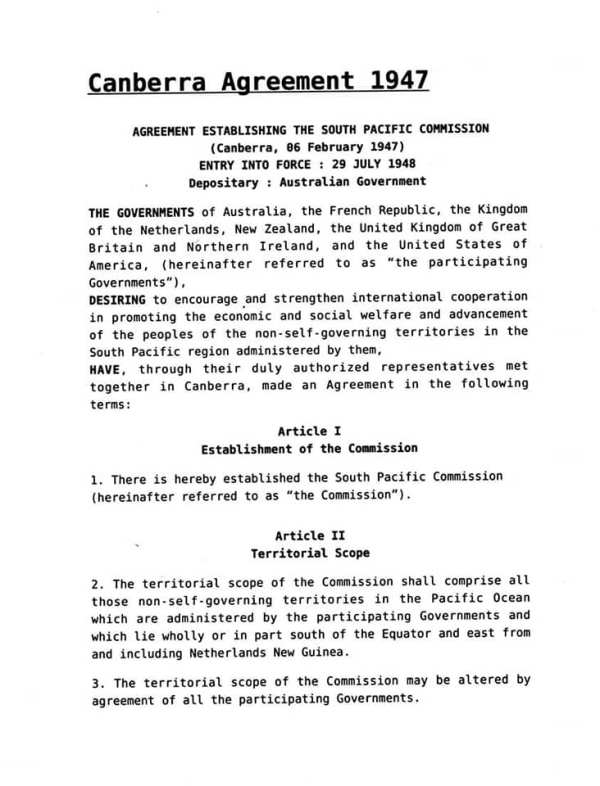
Canberra Agreement 1947 on Establishing the South Pacific Commision

(Canberra , 06 February 1947) ENTRY INTO FORCE : 29 JULY 1948 Depository : Australian Government

THE GOVERNMENT’S of Australia, the French Republic , the Kingdom of the Netherlands , New Zealand , the United Kingdom of Great Britain and Northern Ireland , and the United States of America , ( hereinafter referred to as “the participating Governments”), DESIRING to encourage and strengthen international cooperation in promoting the economic and social welfare and advancement of the peoples of the non-self-governing territories in the South Pacific region administered by them,
HAVE , through their duly authorized representative met together in Canberra ,made an Agreement in the following terms :

Article I.
Establishment of the Commission.
1. There is hereby established the South Pacific Commission (hereinafter referred to as “the Commission”)

Article II
Territorial Scope
2. The territorial scope of the Commission shall comprise all those non-self-governing territories in the Pacific Ocean which are administered by the participating Governments and which lie wholly or in part south of the Equator and east from and including Netherlands New Guinea. (West Papua)


Blog at WordPress.com.

Up ↑

Design a site like this with WordPress.com
Get started